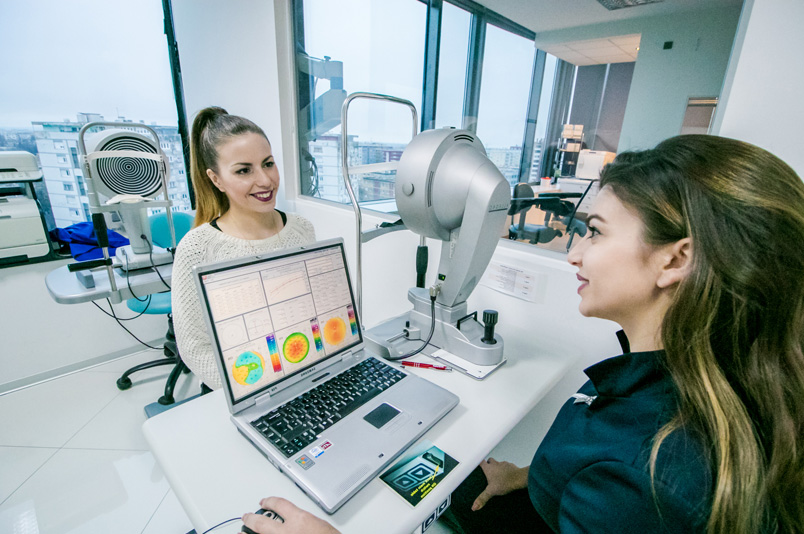
Poliklinika Knezović's own protocol for treating keratoconus - PTK, DISC Ablation and CXL in a single procedure.
Price 2.700 €Price on 10.09.2026.: 2.700 €The DISC Protocol is Poliklinika Knezović's own combined protocol for treating keratoconus, which brings together three procedures in a single operation: phototherapeutic keratectomy (PTK), DISC Ablation reshaping of the cornea and corneal collagen cross-linking (CXL). The aim of the protocol is to halt the progression of the disease and, depending on the findings, to improve the quality and sharpness of vision at the same time.
The DISC Protocol is considered for patients with diagnosed keratoconus in whom, in the doctor's judgement, it is appropriate to combine stabilisation of the cornea with improvement of its shape in the same procedure. The suitability of the protocol depends on the degree and regularity of corneal deformation, its thickness and the dynamics of disease progression so far, so the decision is always made individually, after detailed diagnostics.
Before the procedure, an extensive diagnostic assessment of the cornea is carried out so that the doctor can precisely plan all three phases of the protocol. The procedure is performed in one go, on an outpatient basis, followed by a healing period during which the condition of the cornea is closely monitored. Depending on the findings, the doctor carries out regular check-ups during the year after the procedure to monitor the effect of the protocol and the stability of the cornea.
The advantage of combining three procedures into one operation, according to Poliklinika Knezović's experience, is that the stabilisation of the cornea and the improvement of its shape happen within the same time frame, rather than through several separate interventions. Depending on the findings, this can simplify the course of treatment and follow-up for the patient. As with any corneal procedure, the final outcome depends on the individual characteristics of the eye, the stage of keratoconus at the time of the procedure and consistent adherence to the doctor's instructions during the healing period.
Unlike most other eye diseases, keratoconus affects a younger population - it is often diagnosed in adolescents in their 20s. Younger age groups are the most at risk when it comes to disease progression, and if keratoconus is not treated, it can progress, most often until around the age of 30 or longer. It occurs equally in both sexes.
In its early stage, keratoconus is very difficult to recognise without appropriate equipment at an ophthalmological examination, that is, topographic and tomographic analysis. The most common symptoms patients can notice themselves are deteriorating quality of vision, progressive growth of myopia and astigmatism, double vision, increased sensitivity to light and glare. Keratoconus can also be recognised by the fact that after some time glasses no longer help to improve visual acuity and it is difficult to determine the dioptre.
The NOVA Vision® treatment planning software integrates data from the anterior and posterior surfaces of the cornea using a Scheimpflug tomograph and advanced algorithms to calculate the optimal laser ablation. The software generates personalised output data, including the exact location, decentration, optical zone and ablation depth, and the predictive model uses machine learning algorithms based on successful surgical procedures.
Compared with other methods, according to the description of the method the DISC Protocol offers better visual acuity thanks to precise, individually adapted laser procedures, a shallower laser treatment that is less invasive for the patient, more predictable and consistent results, and long-term stability of the cornea. Unlike standalone cross linking, which primarily strengthens the cornea without correcting refractive errors, the DISC Protocol combines laser procedures with strengthening of the cornea, thereby stabilising the disease and improving vision at the same time.
Before the procedure, you need to undergo a detailed specialist examination, which includes a vision and refraction check, examination of the anterior segment of the eye, eyelids, conjunctiva and tear film, examination of possible changes on the cornea, examination of other structures visible with a slit lamp (Vogt's striae, scars, Fleischer ring and others), tomographic analysis, anterior OCT, AL scan, corneal topography, endothelial microscopy and measurement of intraocular pressure.
The procedure is highly safe because the laser ablations are shallower than with similar methods. As with any other operation, complications are possible, such as transient corneal haze (clouding of the cornea), short-term fluctuations in tear film quality or post-operative discomfort in the eye during the first 3 days after the procedure. According to results to date, over 98% of treated patients have no worsening of keratoconus and no post-operative complications, while in fewer than 2% of those treated, transient complications such as haze or fluctuations in tear film quality are possible, which can be resolved through regular post-operative check-ups.
The procedure consists of several laser procedures on the cornea and strengthening of the cornea, that is, corneal cross-linking. It takes about an hour and is completely painless thanks to anaesthetic drops. The steps in the DISC Protocol are NOVA Vision scanning of the cornea and creation of the operative plan, PTK, that is, laser removal of the epithelial layer on the corneal surface (individually calculated for each patient), DISC ablation as the most important laser treatment, which ensures better quality of vision, and corneal cross-linking, which strengthens the corneal tissue and provides long-term stability.
Half an hour after the operation, the patient goes home with a discharge letter and complete therapy (eye drops) to be used for the following month. During the first 3 days you may feel mild stinging and a gritty sensation in the eye, as the healing is superficial. Until the first check-up, which takes place after 4 days, it is recommended to stay at home, rest and use the prescribed therapy. At the first check-up the special contact lens is removed and the eye is examined with a biomicroscope, and the next check-up is, depending on the case, a month later. Vision improves slowly, and in some patients continues to improve throughout the whole year after the procedure, as the cornea becomes more regular and clearer. Results are long-lasting in the vast majority of patients, and repeat treatment is needed in fewer than 2% of cases. We recommend a check-up at least once a year so that we can regularly monitor the condition of the cornea.
The DISC Protocol costs 2.700 €, and, according to the service description, this price includes check-ups and diagnostics for a year after the procedure. Before the protocol, a keratoconus examination costing 150 € is required. A detailed overview of prices is available on the Price list page, and the doctor assesses the suitability of the protocol for your case after diagnostic assessment.
If you have been diagnosed with keratoconus and would like to know whether the DISC Protocol is a suitable approach in your case, book an appointment for an examination, and for further questions contact us through the Ask the doctor page.
| Service | Booking | Price |
|---|---|---|
| Examination for keratoconus | e-Booking | 150 €Price on 10.09.2026.: 150 € |
| Corneal cross-linking (CXL) epi-off | 1.000 €Price on 10.09.2026.: 1.000 € | |
| Corneal cross-linking (CXL) epi-on | 1.000 €Price on 10.09.2026.: 1.000 € | |
| DISC ProtocolPTK + DISC Ablation + CXL | 2.700 €Price on 10.09.2026.: 2.700 € | |
| Athens ProtocolPTK + TGP + CXL | 2.200 €Price on 10.09.2026.: 2.200 € | |
| Post-operative check-up | On request |
The prices include follow-up examinations and all diagnostic tests for a period of one year
The regular price is crossed out and the price valid today is highlighted. Next to each item, the price that applied on 10.09.2026. is also shown (Decision on displaying an additional price, NN 101/2026).
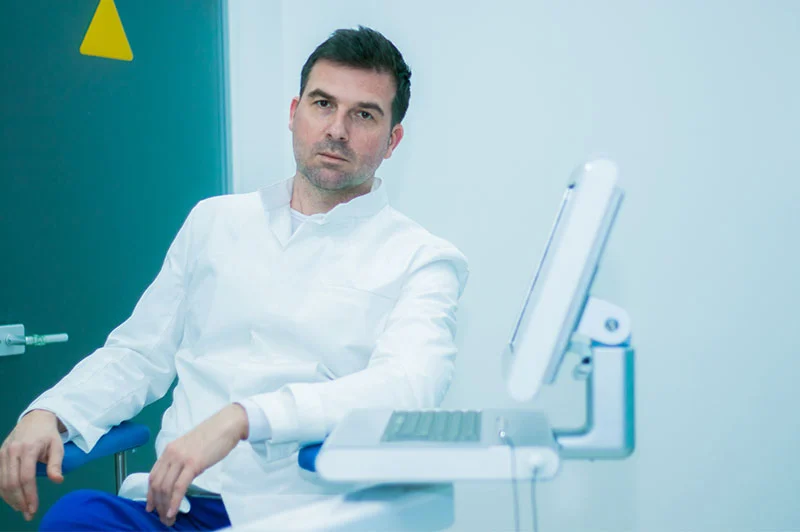
Specialist in ophthalmology, founder of Poliklinika Knezović
Expert in diseases of the anterior segment of the eye and in laser treatment of keratoconus. More than 25 years in ophthalmology, with training at leading centres around the world.
Answers to the questions patients most often ask about the DISC Protocol.
Every eye is different. The doctor decides on the method only after an examination and diagnostics. Book an appointment and you will receive a clear recommendation and an exact quote, with no obligation.