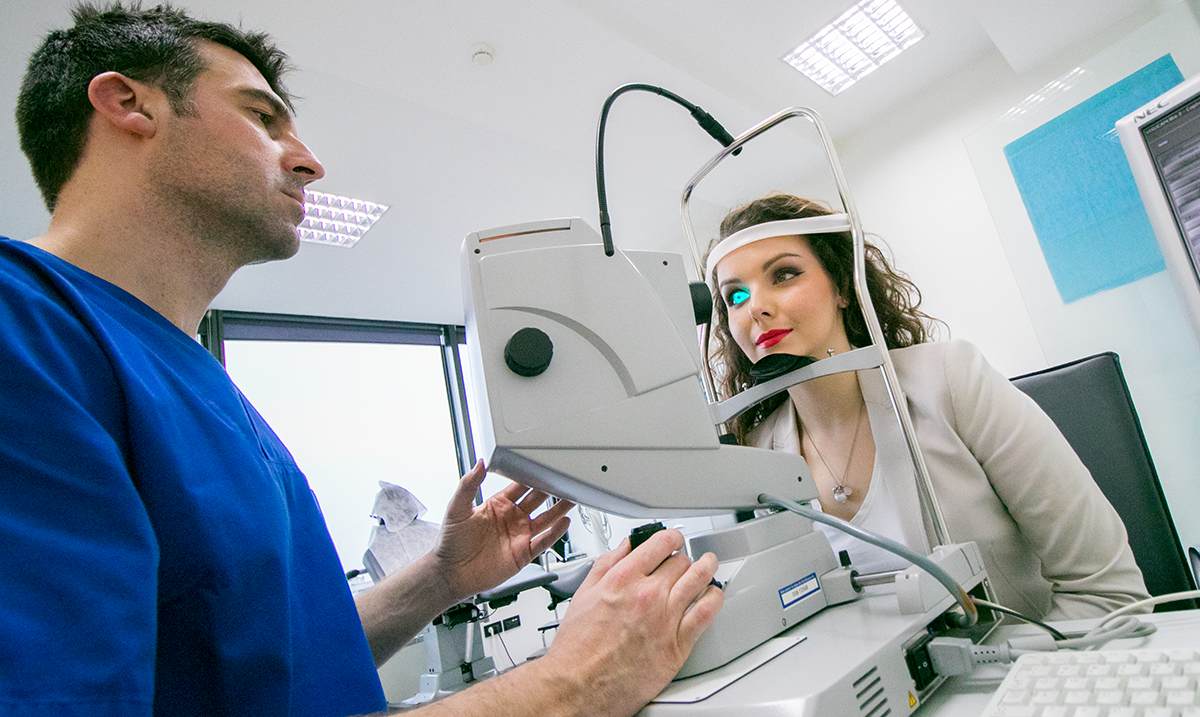
It is never too early to check a child's vision. There are specialised instruments with which vision can be examined even in small babies. A routine examination for children...
Price of the examination 80 €Price on 10.09.2026: 80 €It is never too early to check a child's vision. There are specialised instruments with which vision can be examined even in small babies. For children between 4 and 6 years of age, before starting kindergarten or school, a specialist eye examination should also be carried out, especially if there are vision problems in the family or you have noticed any symptoms of reduced visual acuity. According to the recommendation of the World Health Organization, the examination should be done by the age of four as prevention of amblyopia (lazy eye) and for early influence on visual acuity disorders.
The most common vision problems in children are short-sightedness, long-sightedness and astigmatism, but strabismus and other conditions that can cause amblyopia also occur.
Undetected vision problems in early youth can lead to learning difficulties, behavioural problems and poor grades at school. It is very important to spot vision problems early, because the earlier they are detected, the better the treatment results in children.
A child should be taken for an examination once a year, or as needed if they show symptoms that their prescription has changed.
There are many signs and symptoms that may suggest a child's vision is not excellent. For example, the child complains of poorer vision, or moves closer to the objects they are looking at (whether distant or nearby). Changes in head position while watching, for example, television, or covering one eye, can also be signs. Rubbing the eyes and excessive tearing can likewise be symptoms of poorer vision and a signal that it is time to visit a paediatric ophthalmologist.
Strabismus, or a turning eye, is a disorder of eye position: in a normal state the eyes are parallel and follow movements equally. In strabismus the eye turns to the side (less often both eyes), and a refractive error is usually associated with it. The brain simply neglects that eye, and the eye becomes amblyopic. That is exactly why early examination and detection are so important, after which exercises can be carried out and the necessary correction worn so that the development of vision becomes stable and the problem can be influenced. As the child gets older, the chance of treating strabismus with exercises falls significantly.
Amblyopia can also develop as a consequence of strabismus, that is, a turning eye. Vision develops throughout childhood. The most active development of a child's vision is between the ages of two and three, when some errors can appear. To have a complete picture, the brain simply ignores the eye that has either strabismus or a refractive error and looks with the healthy eye.
Amblyopia needs to be detected in time so that it can be influenced. Wearing an occlusion patch over the eye, wearing prescription correction, or strabismus surgery are some of the possible solutions for amblyopia.
Complete eye examination for children – the price is 400 kuna. See current special offers in our price list–>
A specialist eye examination for children includes not only
Skiascopy is performed by imaging on an automated computerised refractometer, after the child's pupil has been dilated with 1% tropicamide drops. It allows us to objectively determine the prescription in small children up to school age.
The duration of the examination is 60 minutes.
Before the examination
An eye examination is important for children because, to learn more easily, they need these basic vision-related skills: good near and distance vision, spatial coordination, the skill of moving and focusing the eyes correctly, peripheral awareness, and eye-hand coordination. It is advisable to explain to your child before the examination where they are going and what they will do there.
After the examination, because of the dilated pupils, the child will have poorer vision for two to three hours. If skiascopy shows surprising results, the child is booked for a follow-up examination to determine the final prescription, which is included in the price of the complete examination for the child.
Items from the clinic's price list for this service. The final price depends on the findings and the doctor's assessment.
Full price listThe regular price is crossed out and the price valid today is highlighted. Next to each item, the price that applied on 10.09.2026. is also shown (Decision on displaying an additional price, NN 101/2026).
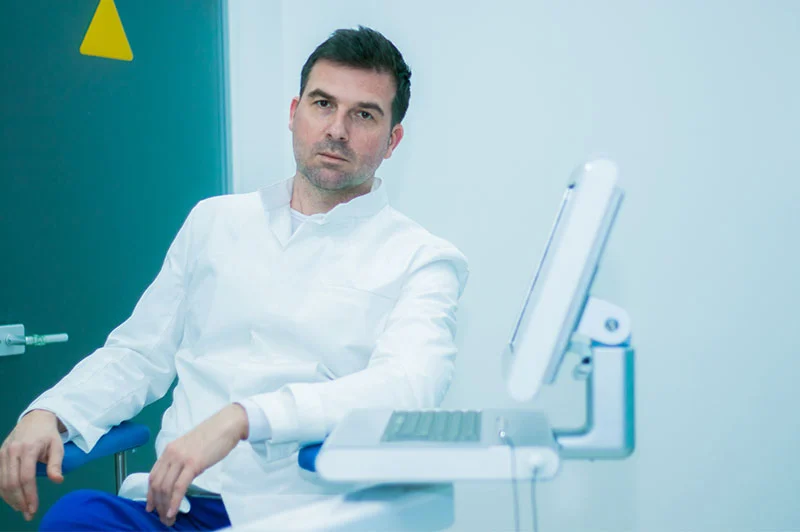
Specialist in ophthalmology, founder of Poliklinika Knezović
Expert in diseases of the anterior segment of the eye and in laser treatment of keratoconus. More than 25 years in ophthalmology, with training at leading centres around the world.
Every eye is different. The doctor decides on the method only after an examination and diagnostics. Book an appointment and you will receive a clear recommendation and an exact quote, with no obligation.