Age-related macular degeneration is a disease of the central part of the retina that destroys central vision and is associated with ageing. Macular degenerati...
Retinal examination 90 €Price on 10.09.2026.: 90 €Age-related macular degeneration is a disease of the central part of the retina that destroys central vision and is associated with ageing. Macular degeneration affects the yellow spot (macula), which is the site of sharpest vision.
AMD occurs in two forms - dry (85% of all macular degenerations) and wet (15%).
Dry form of age-related macular degeneration causes slow deterioration of the pigment cells of the retina and death of photoreceptors. Vision loss can be gradual or sudden, if the dry degeneration has advanced or has turned into the wet form of the disease.
The wet form of age-related macular degeneration is characterised by the growth of new blood vessels beneath the macula. These newly formed blood vessels are fragile, which causes bleeding and fluid leakage. The result is thickening and damage to the macula with distortion of the image and rapid loss of central vision.
GENETICS – there are certain gene mutations associated with the disease
AGE – over 60 years
SEX – somewhat more common in women
LIFESTYLE – smoking, obesity, unprotected exposure to UV radiation, uncontrolled hypertension and high cholesterol
The cause of this disease is a degenerative change in the yellow spot - the site of sharpest vision.
Age-related macular degeneration is not painful. The most common initial symptom of the dry form is blurred vision, which results in poorer recognition of details and things in front of you. If a large number of photoreceptors in the macula are lost, those affected may see a small and then growing black spot in the centre of the visual field. On the other hand, the classic initial symptom of the wet form of age-related macular degeneration is distortion of a straight line, i.e. of the image, which is called metamorphopsia.
A complete ophthalmological examination is carried out with pupil dilation, a test with the Amsler grid (which the patient takes home for further self-monitoring), visual field testing and OCT.
There is no specific treatment for the dry form - vitamin supplements containing lutein are prescribed.
The wet form of age-related macular degeneration is today treated effectively with so-called smart drugs, i.e. anti-VEGF therapy. These medicines prevent the growth of new blood vessels and cause them to regress, so the bleeding is reduced or stops, reducing the oedema, i.e. the thickening of the macula. This therapy is the leading treatment for the wet form of age-related macular degeneration.
You can find the prices for treating age-related macular degeneration in our current price list
Your retina specialist may sometimes, if they consider it appropriate, suggest laser treatment of newly formed leaking blood vessels.
Poliklinika Knezović has many years of experience with various methods of monitoring and treating age-related macular degeneration, and a top team of specialists working in this field. We were among the first in the region to introduce optical coherence tomography of the retina (SOCT), a prerequisite for diagnosing and monitoring therapy in diseases of the macula.
To date, several thousand procedures on the posterior segment of the eye have been performed, with excellent results.
Prim.dr.sc Borna Šarić is among the top vitreoretinal surgeons, with many years of experience in the diagnosis and treatment of diseases of the posterior segment of the eye. He is a regular lecturer at national and international professional conferences and a pioneer in performing the most complex operations on the anterior and posterior segments of the eye.
People with age-related macular degeneration rarely go completely blind. Even with advanced macular degeneration, a more serious form of the disease and a defect in the centre of the visual field, patients can still see objects in the periphery of the visual field.
The dry form, which is also the more common one, usually progresses more slowly and gradually. The wet form may sometimes return even after treatment. That is why it is important to monitor the condition in cooperation with a retina specialist.
The wet form usually progresses quite quickly and, without timely treatment, can significantly damage vision. The dry form progresses more slowly, but there is no specific medicine for it.
Need a second opinion? Send us your test results
Točan iznos ovisi o nalazu i procjeni liječnika. Sve cijene pogledajte u cjeniku.
Full price listCijena prema važećem cjeniku poliklinike.
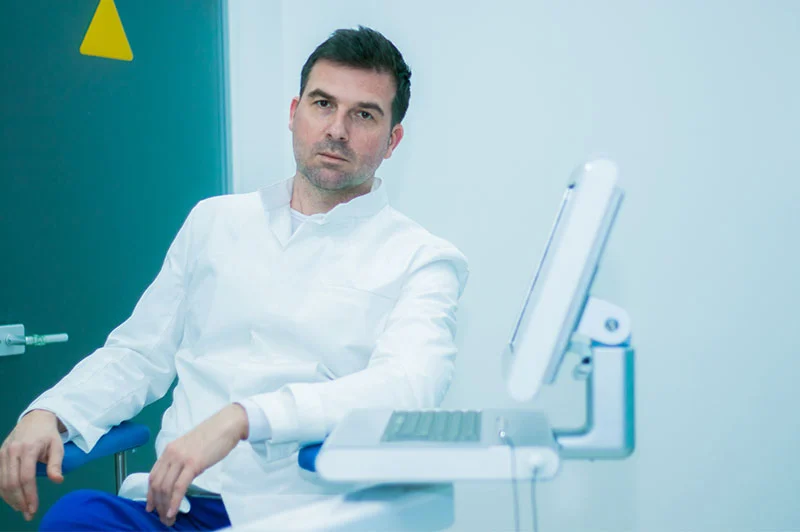
Specialist in ophthalmology, founder of Poliklinika Knezović
Expert in diseases of the anterior segment of the eye and in laser treatment of keratoconus. More than 25 years in ophthalmology, with training at leading centres around the world.
Every eye is different. The doctor decides on the method only after an examination and diagnostics. Book an appointment and you will receive a clear recommendation and an exact quote, with no obligation.